
Drying & Cooling
Fluid bed processing has several applications, the most common in process industries being drying and cooling, agglomeration, and air classification. Carrier offers a variety of vibrating fluid bed dryer and cooler systems that have proven reliable in applications around the world, and its designs can be customized to meet your needs. Other industrial drying and cooling equipment include conventional (static) fluid beds, media slurry dryers, flash and tornesh dryers.
Industrial Drying & Cooling Equipment Types
Customized To Your Application
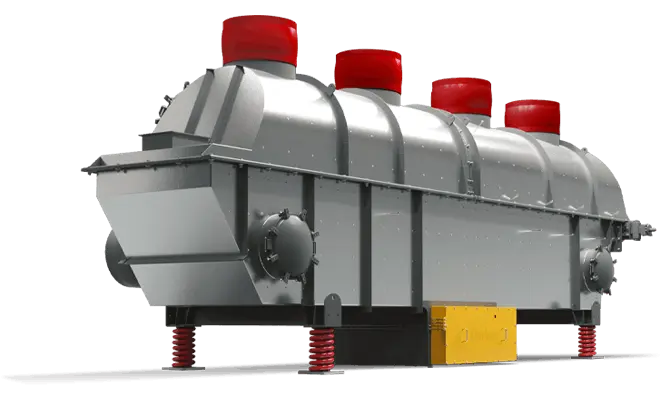
Carrier’s Dryers & Coolers
Carrier’s drying and cooling technologies are engineered to deliver consistent, high-performance results across a wide range of materials and operating conditions utilizing the least amount of energy. Whether handling bulk solids, aggregates, or specialty materials, our solutions provide reliable, scalable performance, helping manufacturers increase productivity, extend equipment life, and maintain strict quality standards.
Vibrating Fluid Bed Dryers & Coolers
Dry and cool a wide range of material types at a variety of feed rates. Ideal for materials with wide particle size distribution.
Conventional / Static Fluid Bed Dryers & Coolers
Provide efficient processing including drying, cooling, classifying and sterilizing with Carrier conventional fluid bed dryers and coolers.
Media Slurry Dryers
Cost-effective in the production of super fine powders from liquid phase reaction or wet grinding operations. High viscosity materials can be pumped directly into a slurry dryer without mixing or atomization.
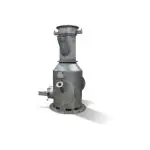
Flash Dryers
Economical solution to dry powders and granular materials. Flash dryers can use higher gas temperatures than other dryers due to a very short material retention time, are capable of processing high capacities in a relatively small amount of space, and are often used as a pre-dryer to expand production capacity on existing lines.
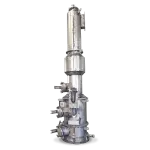
Tornesh Dryers
Combine many of the benefits of fluid bed and flash drying. Process wet solids ranging in size from 1 micron up to one-half inch diameter. Materials to be dried fall to the bottom plenum and begin to swirl in a cyclonic pattern. As moisture is removed from the product, it becomes lighter and eventually is entrained in the upward hot gas stream.
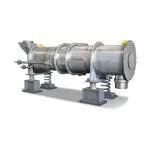
VibroQ & VibroCool
Heat and Cool exchangers provide efficient indirect thermal processing for bulk solids while protecting product quality. Their vibratory design ensures uniform material movement across heat-transfer surfaces for consistent temperatures, high efficiency, and minimal maintenance.
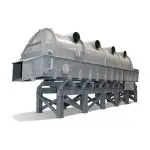
Sand Coolers
Designed for foundry and processing operations, sand coolers efficiently reduce hot return sand to temperature and moisture levels ideal for reuse and mulling. Their vibrating fluid-bed design evenly distributes air through the sand bed to maximize thermal efficiency while preventing pluggage and hot spots.
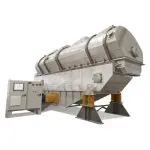
Aggregate / Sand
Dryers & Coolers
Sand and aggregate dryers and coolers are engineered for demanding bulk material operations. These systems provide precise temperature control, uniform material flow, and rugged construction to handle abrasive materials and high throughputs.
The Basic Theory of Fluid Bed Dryers, Slurry Dryers, Flash Dryers & Tornesh Dryers
To understand fluid bed dryer systems, it is important to be familiar with fluid bed operation. Fluid bed processing passes a gas directly through a bed of solid material via a perforated plate, nozzles, ceramic grid or other fluidizing media, lifting and mixing the solids. As the velocity of the air increases, so does the pressure drop across the bed until at a certain flow rate, the frictional drag on the particles equals the material bed’s effective weight. At this fluidizing velocity, the material bed attains fluid-like properties and expands beyond the size of the fluid bed. When the air velocity in the free cross-section is further increased, the bed expands until particles are carried over by the air. By fluidizing the bed, each particle is enveloped in the process gas creating an extremely efficient heat transfer device.